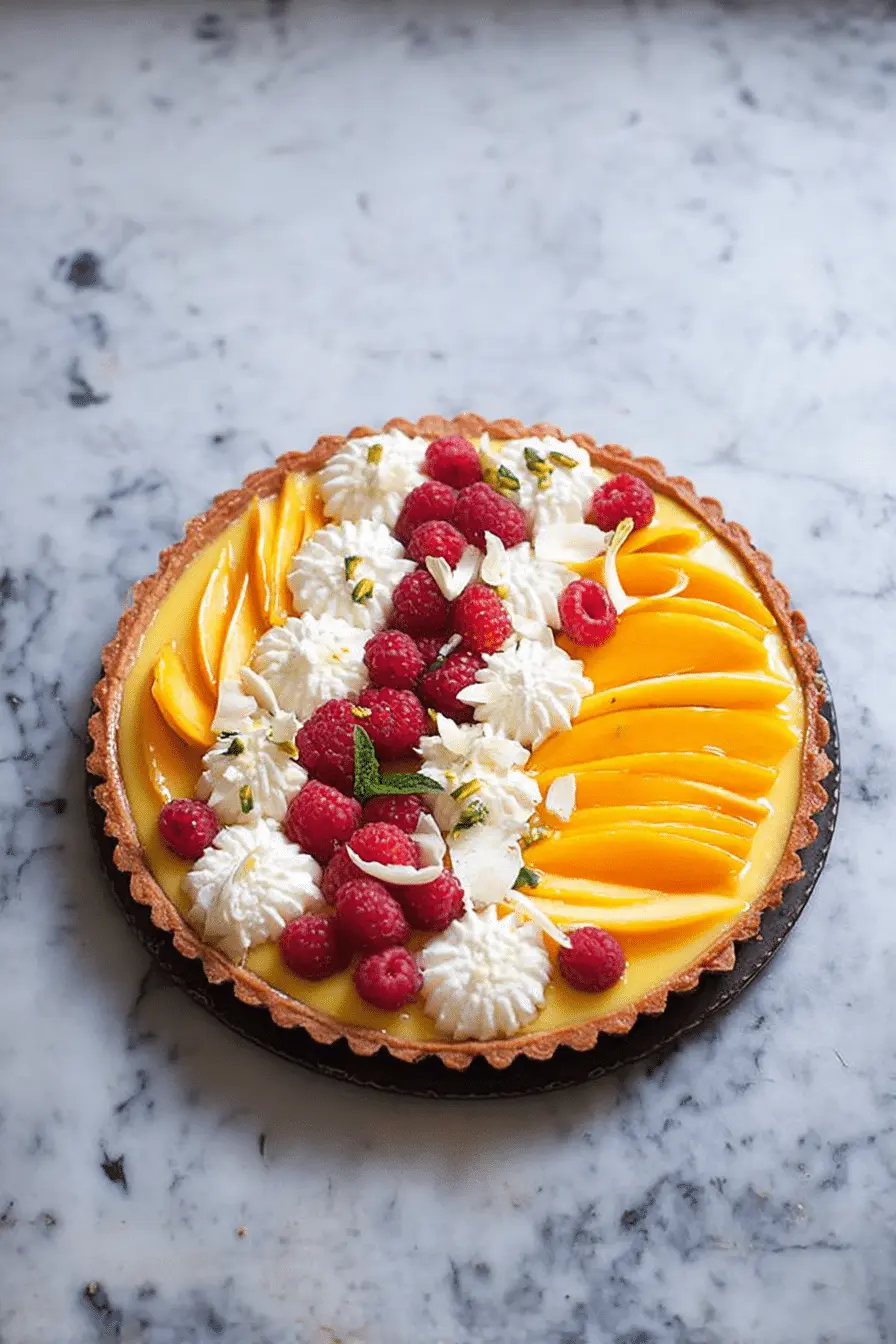
Mango Curd Tart
- Prep
- 30 min
- Cook
- 55 min
- Total
- 95 min
- Serves
- 8
- Calories
- 320 kcal
- Carbs
- 45.00 g
Introduction
I fell in love with this tart the day I realized lime is the secret weapon for mango: it sharpens the fruit’s natural perfume so the curd reads as pure, sun-soaked mango rather than just syrupy sweetness. In my kitchen I slow-cook the curd over a double boiler until it’s satin-smooth, then pour it into a crisp blind-baked shell. The contrast — glossy, jewel-toned curd against a pale, buttery crust — is the sort of summer dessert that photographs beautifully and vanishes even faster than it looks.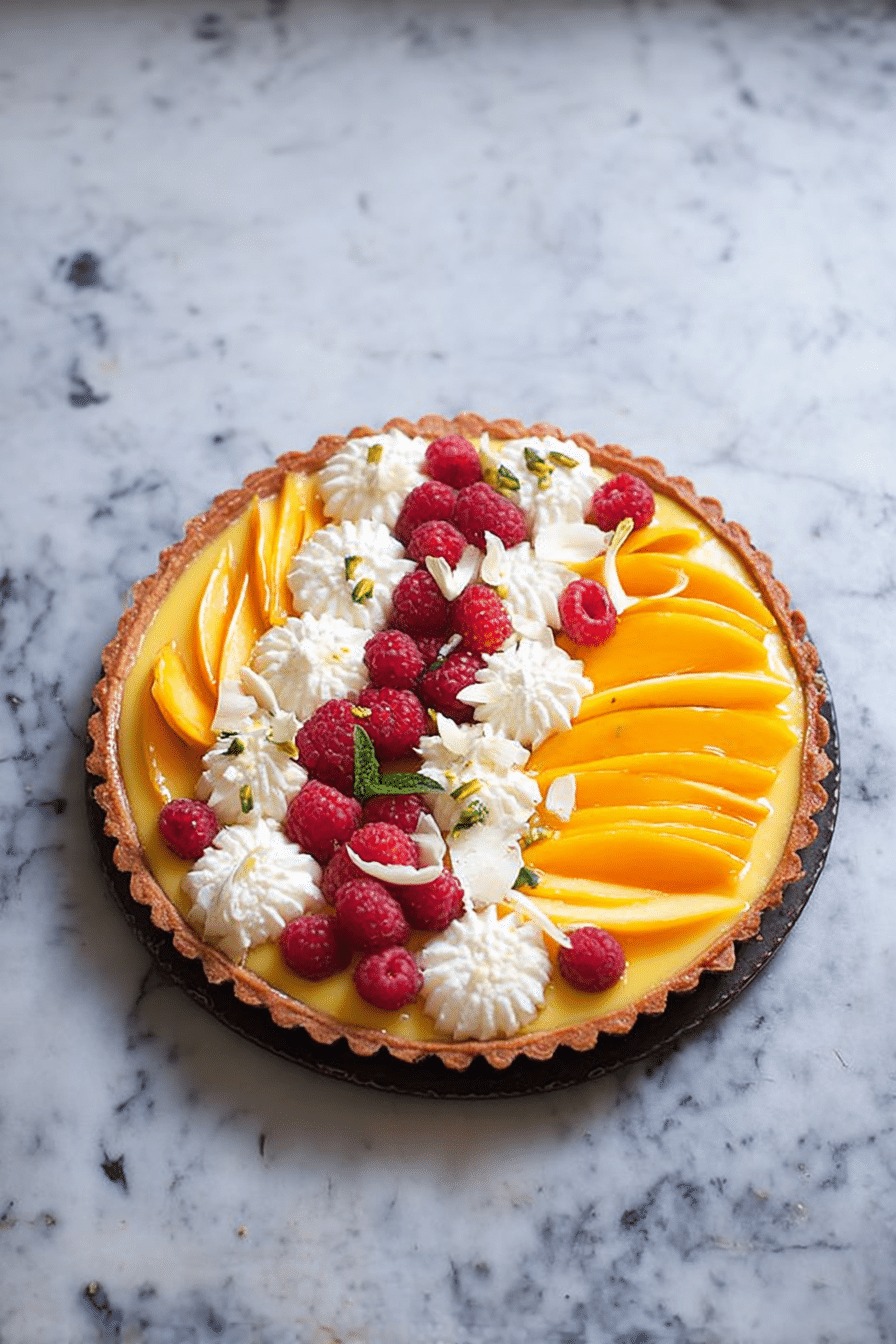
Why This Mango Curd Tart is Perfect for Summer Gatherings
This tart channels summer in three ways: flavor, color and ease of serving. The mango-lime curd smells like ripe fruit and citrus peel; the aroma is bright and immediate. Visually, the glossy curd makes an irresistible centerpiece when edged with sliced mangos, raspberries and halved cherries — those contrasts of orange, red and dark cherry are striking on a white platter. It’s also versatile for hosting: make the curd ahead and keep it chilled, blind-bake the shell the day before, and assemble on the event day so you’re not stuck in the kitchen. I’ve taken this to picnics (cover it snugly and keep it cool) and to casual BBQs where it reads as both elegant and approachable. When you want something that looks celebratory but is manageable to produce in advance, this tart fits that exact moment.Everything You Need for Mango Curd Tart
Below I walk through the ingredients and tools in plain language so you’ll know what each one does and what to swap if your pantry looks different. Use room temperature ingredients where noted so your dough and curd emulsify smoothly.- Almond meal – Adds a tender, slightly nutty crumb to the crust; swap in more flour for a plain shortcrust or use additional almond meal for a nuttier profile.
- All-purpose flour – The structure of the tart shell; for gluten-free, use a reliable gluten-free flour blend formulated for pastries.
- Confectioners' sugar – Dissolves quickly in the dough for a fine-textured crust and a subtle sweetness.
- Butter – Provides flavor and flakiness; use unsalted so you can control seasoning.
- Egg yolks (for dough and curd) – Yolks enrich the crust and thicken the curd, giving that silky mouthfeel you want in a curd-based tart.
- Mango puree – The star ingredient; you can use canned puree or make your own by blending ripe mangos and straining them for a smooth finish. If you have fresh ripe mangos, you can blend them to make your own puree. Just make sure it's well strained for a smooth curd.
- Lime juice – Brightens the mango and keeps the curd from being cloying. If you don't have lime juice, lemon juice is a fine substitute and will keep the tart's acidity balanced.
- Sugar – Balances the fruit; increase slightly if your mango puree is unsweetened.
- Salt – A pinch lifts the fruit flavors and rounds the sweetness.
- Fresh fruit for topping – Think sliced mango, raspberries and halved cherries for color and contrasting tartness. Seasonal berries or stone fruits also work beautifully.
- Whipping cream – Whipped lightly as a finishing touch; keeps the plated portions light and elegant.
- Tools – You'll need a tart pan with removable bottom, a stand mixer or bowl and paddle, a double boiler setup or a heatproof bowl over simmering water, a fine-mesh strainer, and pie weights or beans for blind-baking.
How to Make Mango Curd Tart (Step-by-Step)
- Make the crust: cream butter and confectioners' sugar, add the egg yolk, then mix in the dry ingredients until the dough just comes together. Press immediately into your tart pan or chill the disk briefly if you prefer to roll it.
- Roll and fit: roll the dough between plastic sheets for an even thickness, then drape it into the pan and gently press into the edges. Trim the excess and chill or freeze the shell briefly to prevent shrinkage.
- Blind-bake the shell: line with foil and fill with pie weights or beans, then bake until the edges are set and beginning to color. Remove weights and bake briefly again if the base needs additional browning.
- Prepare the curd over a double boiler: whisk together mango puree, lime juice, sugar, salt and egg yolks in a heatproof bowl set over simmering water. Stir constantly and gently until the mixture thickens and coats the spatula; this slow, steady heat is what yields a satiny curd.
- Finish and strain: stir in butter until glossy, then pass the curd through a fine-mesh strainer to remove any coagulated bits for a glassy finish.
- Assemble and bake briefly: pour the curd into the pre-baked shell and bake at a low temperature until the curd is set to the touch — warmer curd will set faster, chilled curd will take longer. Allow to cool to room temperature before chilling so the curd firms without sweating.
- Top and serve: arrange sliced mango, raspberries and cherries on the chilled tart, whip cream to medium peaks with a touch of confectioners' sugar and pipe or spoon as a finishing flourish.
The Secret to the Perfect Texture of Your Curd
Achieving a silken curd is all about gentle heat, patience and a final polish. Gradual heating prevents the egg yolks from scrambling; keeping the water at a bare simmer and stirring continuously ensures the proteins denature slowly and the curd thickens uniformly. Overcooking concentrates proteins and can make the curd grainy — pull it off the heat when it just coats the back of a spatula. Straining after cooking is non-negotiable for a refined texture: it removes any tiny cooked flecks and gives you that glass-like finish that looks great sliced and holds well under fruit toppings. Troubleshooting (I’ve tested these fixes in my kitchen):- I noticed graininess when I rushed the heat — if the curd looks grainy, warm it gently while whisking and add a splash of liquid (mango puree or a little water) to help smooth it, then strain.
- If the curd seems thin, continue heating very slowly until it reaches the napé stage (it should coat a spoon); remember that it will thicken more as it cools and when chilled in the shell.
- If the curd curdles (small scrambled bits form), remove it from heat immediately and whisk in a small amount of room-temperature mango puree to re-emulsify, then strain.
Customizing Your Mango Curd Tart with Seasonal Fruits
Seasonal fruit changes the personality of this tart. In early summer I lean into raspberries and cherries for color and tart counterpoint; later in the season, stone fruits like nectarines or sliced peaches add juiciness and warmth. Tropical touches — thinly sliced pineapple or passionfruit seeds — make the tart feel more exotic. To balance sweetness, pair very ripe, sweet mango with small tart berries; to boost visual drama, arrange fruit in concentric rings, fan thin mango slices, or pile berries in the center for a spontaneous look. For guidance on fruit pairings, seasonal fruits like raspberries, cherries, or even tropical fruits like pineapple work beautifully with mango curd tart!Pairing Suggestions for Your Mango Curd Tart
This tart pairs well with beverages and small bites that either echo the tropical fruit or cut through the sweetness.- Wines: A dry Riesling or an off-dry Gewürztraminer amplifies mango’s floral notes without overwhelming the dessert.
- Cocktails: Light rum with soda and lime, or a sparkling cocktail with a splash of mango liqueur keeps the pairing airy and summery.
- Non-alcoholic: I like iced green tea with a squeeze of lime or a hibiscus iced tea for a tart counterpoint.
- Savory pairings: Serve small bites like prosciutto-wrapped melon or a simple fennel and citrus salad before dessert to keep the meal balanced and festive.
Pro-Tip for Achieving the Perfect Mango Curd Consistency
Note: The Pro-Tips and Troubleshooting and Variations sections are presented as bulleted lists for easy scanning.- Use a double boiler and keep the water at a gentle simmer — direct, high heat is the enemy of smooth curd.
- Temper your egg yolks by slowly whisking a little hot mango mixture into them before returning everything to the heat; this prevents sudden coagulation.
- Stir constantly with a flexible spatula and watch for the napé stage: the curd should coat the spatula and leave a clear line when you run your finger through it.
- Always strain the curd and then chill it before baking into the shell if you want a shorter bake time and an ultra-smooth surface.
Storage Tips for Leftover Tart or Curd
Store assembled tart: cover and refrigerate the whole tart and consume within a few days to keep the fresh fruit from breaking down. You can store the leftover tart in the refrigerator for up to 3 days. If you need longer storage, remove the fruit topping and freeze slices wrapped tightly; texture will change slightly on thawing. Store curd separately: spoon the cooled curd into an airtight container and refrigerate for several days, or freeze in portions for longer keeping. When reheating frozen curd, warm gently and whisk to restore silkiness — do not boil.Variations to Try with Your Mango Curd Tart
Below are simple ideas to inspire variation; these are listed as bulleted options to make it easy to pick a direction.- Passionfruit curd: substitute passionfruit puree for mango for a tangier, tropical finish.
- Berry curd: blend raspberries or strawberries for a berry-forward tart with the same curd technique.
- Gluten-free crust: use a gluten-free flour blend or an almond-meal-forward crust for nutty flavor and tender bite.
- Nut crust: swap some flour for ground pistachio or hazelnut for aroma and texture.
- Herbed curd: infuse the curd with a small amount of fresh basil or Thai basil for an herbal lift, or add a touch of grated ginger for warmth.
- Coconut variation: fold a little toasted shredded coconut into the crust and top with toasted coconut flakes for texture contrast.
Frequently Asked Questions
Can I use fresh mango instead of canned puree? Absolutely! If you have fresh ripe mangos, you can blend them to make your own puree. Just make sure it's well strained for a smooth curd. How can I make the tart crust gluten-free? You can substitute the regular flour with a gluten-free flour blend. Just ensure to use a blend that works well for baking. What can I use as a substitute for lime juice? If you don't have lime juice, lemon juice is a great alternative. It will keep the tart's acidity balanced. How long can I store leftover mango curd tart? You can store the leftover tart in the refrigerator for up to 3 days. Just make sure to cover it well to maintain freshness. What fruits pair well with mango curd tart? Seasonal fruits like raspberries, cherries, or even tropical fruits like pineapple work beautifully with mango curd tart!Recipe Card
Mango Curd Tart
- Prep
- 30 min
- Cook
- 55 min
- Total
- 95 min
- Serves
- 8
- Calories
- 320 kcal
- Carbs
- 45.00 g
Ingredients
- 1/4 cupalmond meal or flour
- 1 1/4 cupsbleached all-purpose flour
- 1/2 cupconfectioners' sugar
- —pinch salt
- 10 tbspsoft butter
- 1 largeegg yolk
- 1 1/4 cupscanned mango puree
- 1/4 cuplime juice
- 1/3 cupsugar
- —pinch salt
- 6egg yolks
- 4 tbspunsalted butter
- 2mangos (peeled and sliced thin)
- 1 cupraspberries
- 1 cuppitted, halved cherries
- 1 cupwhipped cream
- 1 tbspconfectioners' sugar
Instructions
- 1
In a Stand Mixer cream the butter and sugar with the Beater Blade. Then add the yolk and mix to combine. Add the flour and salt, blend until it comes together.
- 2
You can immediately press the dough into a 9 to 10-inch Tart Pan with Removable Bottom or form the dough into a disk and wrap it in plastic. Refrigerate for at least an hour.
- 3
Roll out between a Nonstick Silicone Baking Mat (or wax paper) and a sheet of plastic wrap.
- 4
Use the silpat to pick up the dough and drape it over the tart pan. The dough will certainly break apart and you will have to press it into the pan, but by rolling it out you will have a uniform thickness.
- 5
Scrape off the excess dough from the top of the pan. Freeze the dough for about 15 minutes while the oven preheats to 350 degrees.
- 6
Fill the tart shell with foil and baking beans or Pie Weights. Bake for about 20 minutes.
- 7
In a bowl set over a double boiler, mix together the mango, lime, sugar, salt and yolks. Use a rubber spatula to stir it until it starts to thicken. Then stir in the butter. Once it is thick, strain the curd.
- 8
To make the tart, pour the curd into the prepared tart shell and bake at 325°F until the curd is set (this can take 15-20 minutes for curd that is still warm or up to 35+ minutes for chilled curd). Let cool to room temperature, then refrigerate until well chilled.
- 9
To garnish, add the sliced mango, raspberries and cherries.
- 10
Whip the cream to medium peaks and pipe over the curd. Serve the remaining cream with the sliced tart.
You might also like
Reviews
Be the first to review this.