

I grew up with tres leches cake at family gatherings, and over the years I’ve learned which small adjustments turn a good cake into one people remember. In my kitchen, this dessert is as much about the texture as it is about the memory—light as a cloud, but luxuriously soaked, and finished with a clean, cinnamon-sprinkled whipped cream.
When I teach friends how to make tres leches, I start with the story: a deceptively simple sponge soaked in three milks, a dessert that feels celebratory without being fussy. That soaking method is what sets it apart from other cakes—rather than brushing or glazing, the sponge is invited to drink, resulting in a tender but structured cake.
Over the years I’ve made a few mistakes—under-whipped whites, pouring the milk too fast, or using the wrong pan—and each error taught me something useful. I’ll share those exact lessons here so you get a reliably light sponge, an evenly soaked cake, and a stable whipped topping that holds up in the fridge.
Why This Tres Leches Cake Belongs in Your Baking Repertoire
Tres leches is a staple across Central America for good reason: it’s approachable, celebratory, and wildly satisfying. The contrast between an airy sponge and a rich milk soak is what gives it that comforting, nostalgic quality. For me, serving this cake has become a shorthand for hospitality—people immediately relax when a pan comes out.
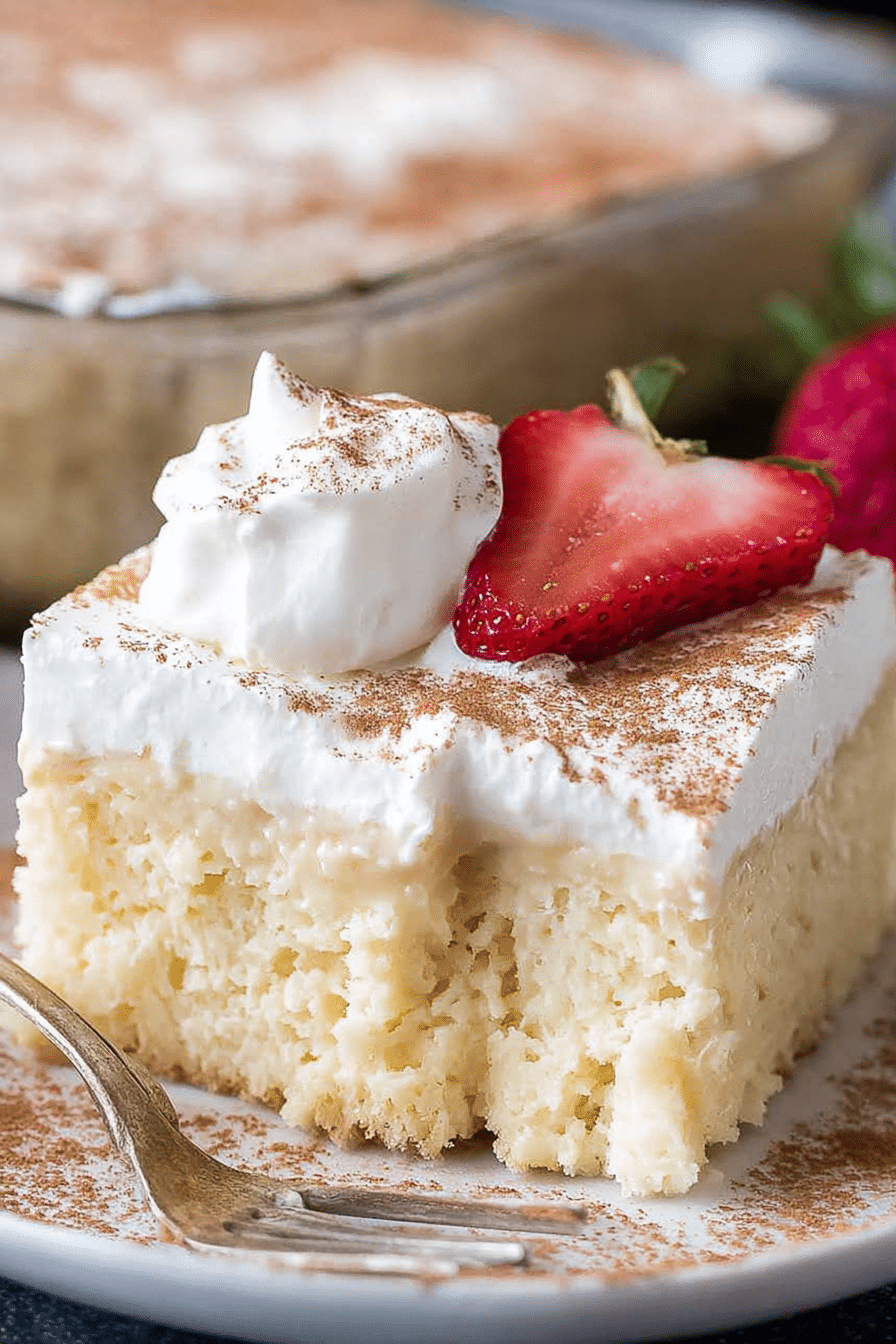
Visually, the cake should look glossy and saturated but not collapsing—think of a velvet sheet of cream hugging a light, golden crumb. Aromatically, the milk mixture with vanilla carries a warm, creamy scent that makes the kitchen feel like a true gathering place.
If you want a sweet pairing, try serving our easy homemade churros alongside this delightful Tres Leches Cake.
Everything You Need for Tres Leches Cake
Below I describe the ingredients and tools in everyday language so you know what each item does and how to choose good versions. I avoid hard measurements here—those will appear in the recipe card handled separately—so focus on purpose and suitable swaps.
- Eggs (separated) – Provide lift and structure; whites become the meringue that lightens the sponge, yolks enrich the batter.
- Butter – Adds flavor and a tender crumb; softened butter incorporates smoothly into the yolk mixture.
- Granulated sugar – Sweetens and stabilizes the meringue when added at the right time.
- Vanilla – Simple aromatic that ties the milks and cake together; use a pure extract for the best result.
- All-purpose flour – Builds the structure; don’t overwork the batter or the sponge will be dense.
- Baking powder – Gives a gentle lift to the sponge; ensure it’s fresh for reliable rise.
- Salt – Balances sweetness and enhances flavor.
- Whole milk – Creates a tender batter when alternated with the flour.
- Sweetened condensed milk – One of the trio of milks; provides sweetness and body to the soak.
- Evaporated milk – Adds a cooked-milk depth and silky mouthfeel to the soak.
- Heavy cream (for soak) – Adds richness and a little fat to the milk mixture, keeping the texture lush.
- Heavy cream and powdered sugar (for topping) – Whips to a light, sweet cloud that balances the dense milks below.
Essential tools
- Stand mixer or hand mixer – For whipping glossy, stable egg whites and finishing the whipped topping.
- 9×13 pan or similar baking dish – A shallow pan helps the milk soak evenly through the sponge.
- Large fork or skewer – To poke uniform holes so the milk can be absorbed without channeling.
- Rubber spatula and whisk – For gentle folding and smooth batter.
The Secret to a Light, Airy Sponge
The sponge is what makes or breaks a tres leches cake—the goal is a cake that’s tender and airy enough to absorb liquid, yet structured enough to hold it. Here are the techniques I rely on every time.
- Bring egg whites to room temperature before whipping; they trap air more readily when not cold.
- Start whipping whites at a low speed to create small, stable bubbles, then gradually increase speed as sugar is added.
- Add sugar to the whites slowly and wait a few seconds between additions so the sugar dissolves and the meringue becomes glossy.
- When folding the meringue into the yolk batter, use a broad spatula and scoop from the bottom up, turning the bowl. Stop as soon as the streaks disappear—over-folding deflates the batter.
- Room-temperature milk and batter mix together more smoothly; cold ingredients can tighten the batter and reduce lift.
- Bake until the top is lightly golden and springs back; an underbaked center won’t support the soak, an overbaked cake will be dry and resistant to absorbing milks.
Soaking Techniques: From Sheet Cakes to Cupcakes
Soaking is where most bakers get nervous. The right method changes with the size and shape of the cake; a shallow sheet soaks faster than individual cupcakes. Here’s how I adjust depending on format.
- For a sheet cake: poke holes evenly across the surface, pushing the skewer to the bottom each time. Pour the milk garnish slowly in batches—give the cake time to absorb between pours so you don’t flood any single area.
- For a deep pan: use slightly larger or more frequent holes and pour more slowly because the center takes longer to absorb.
- For cupcakes: poke two or three holes per cupcake (depending on size), then spoon a measured amount of the milk mixture into each cavity; cupcakes soak quickly, so start with less and add more if needed.
- To check absorption: wait 10–15 minutes after the first pour—if the surface still beads milk, continue in small additions until the top looks uniformly moist but not swimming.
- Chill the cake after soaking so the milks set into the crumb; this also makes slicing neater.
Why Temperature and Timing Matter for Stable Meringue
Meringue stability is surprisingly sensitive to temperature and timing. A glossy, billowy topping needs the right conditions to form and hold. Here are practical tips I use to avoid weeping or collapsing toppings.
- Use a clean, dry bowl and beaters—any grease or residue prevents whites from reaching full volume.
- Room-temperature egg whites whip faster and reach higher volume than cold whites.
- Add sugar gradually once soft peaks form; adding too early keeps the meringue from building structure, adding too late can make it grainy.
- If humidity is high, whip the cream a touch firmer and keep the cake refrigerated until serving—moist air makes meringue and whipped cream soften faster.
- For extra stability, chill your mixing bowl and beaters briefly before whipping the cream, but not the egg-white bowl (egg whites prefer room temp).
How to Make Tres Leches Cake (Step-by-Step)
- Preheat the oven and prepare a shallow baking pan so the batter bakes evenly.
- Whip the egg whites until foamy, then add sugar slowly and continue to whip to stiff, glossy peaks.
- In a separate bowl, cream butter with remaining sugar, then beat in the yolks one at a time and add vanilla.
- Whisk together dry ingredients and alternate folding them into the yolk mixture with milk, keeping additions light and even.
- Gently fold the meringue into the yolk batter until no white streaks remain—keep the motion gentle to preserve air.
- Spread batter into the prepared pan and bake until the top is lightly golden and springs back when touched.
- Cool the cake in the pan for a short time, then let it come closer to room temperature—do not invert.
- Whisk together the sweetened condensed milk, evaporated milk, heavy cream, and vanilla for the soak; strain if you want an extra-smooth finish.
- Poke holes evenly through the cake and pour the milk mixture slowly, allowing time for absorption. Cover and refrigerate for several hours or overnight for best flavor and texture.
- Whip the topping cream with powdered sugar and vanilla to stiff peaks, spread over the chilled cake, and sprinkle with cinnamon if you like.
If you enjoy this recipe, check out our strawberry layer cake for another delightful dessert experience.
Pro Tip for tres leches cake recipe: How to Soak Without Sogginess
- Start with a well-baked sponge—overbaked cakes resist absorption, underbaked ones fall apart when soaked.
- Poke many small holes instead of a few large ones; this distributes the milk more evenly and prevents channels of oversaturation.
- Pour the milk in stages, giving the cake time to absorb between additions—this helps you stop just short of oversaturation.
- Use a shallow pan for even distribution; deeper pans require more patience and slower pours.
- For cupcakes, spoon the milk into the holes rather than pouring to maintain control over the amount each cup receives.
How to Store, Make-Ahead, and Variations for Tres Leches Cake
Tres leches actually benefits from a bit of waiting—make it a day ahead to let the flavors marry and the milks settle into the crumb. Store it covered in the refrigerator; it keeps well for several days, though the texture is best within the first 48 hours.
Complement your cake with a refreshing drink like homemade lemonade—it’s a perfect balance to the sweetness of the cake.
Variations (easy swaps and flavor twists):
- Chocolate tres leches — fold cocoa into the batter and add a touch of chocolate to the milk soak for depth.
- Citrus — add a little orange or lime zest to the batter and a touch of citrus juice to the milk mix for brightness.
- Coffee — dissolve instant espresso in the milk soak for a coffee-kissed version that balances the sweetness.
- Coconut — replace some of the heavy cream with coconut milk and garnish with toasted coconut flakes.
- Vegan-ish option — use a sturdy vegan sponge, replace condensed milk with a coconut condensed alternative, and use full-fat coconut milk to mimic the richness.
Troubleshooting Common Issues with Tres Leches Cake
- If the cake is dry: it was likely overbaked or the milk mixture wasn’t given enough time to absorb—bake until just set and allow longer soaking time.
- If the cake is soggy and collapsing: too much liquid or too-large holes; reduce the amount of soak and pour in stages next time.
- If the meringue or whipped topping weeps: either the topping wasn’t whipped enough to stabilize or humidity is too high—whip to firmer peaks and keep refrigerated.
- If the cake tastes flat: make sure to include a pinch of salt in the batter and good-quality vanilla in the milks to layer flavor.
- If slices are messy: chill the cake thoroughly before slicing and use a sharp, hot knife wiped between cuts for clean portions.
For a perfect end to your meal, consider making a classic rhubarb crisp to balance the richness of the cake.
Frequently Asked Questions
What is Tres Leches Cake?
Tres Leches Cake is a traditional Central American dessert made with a light sponge cake soaked in three types of milk: evaporated milk, sweetened condensed milk, and heavy cream. It’s known for its rich flavor and moist texture.
Can I make Tres Leches Cake ahead of time?
Yes! In fact, Tres Leches Cake is best when it has time to soak up the milk mixture. You can prepare it a day in advance and keep it in the refrigerator until you’re ready to serve.
How do I prevent my cake from becoming soggy?
To prevent sogginess, make sure you poke holes in the cake to allow the milk mixture to soak in evenly. Use only the amount of milk mixture that the sponge can absorb without becoming overly saturated.
What can I use as a topping for Tres Leches Cake?
The traditional topping for Tres Leches Cake is a simple whipped cream. You can also sprinkle it with ground cinnamon or add fresh fruit for extra flavor.
Is it possible to make variations of Tres Leches Cake?
Absolutely! You can experiment with different flavors by adding fruit purees, flavored extracts, or altering the milk mixture. People often create variations like chocolate or fruit-flavored Tres Leches Cake.
Tres Leches Cake Recipe
Ingredients
Method
- Preheat oven to 350F (175C) and spray a 9x13 glass baking dish with baking spray. Set aside.
- Place egg whites in a large bowl or in the bowl of a stand mixer and use an electric mixer to beat until foamy. Gradually increase mixer speed to medium-high and add just 1 cup (200g) of sugar, adding about 2 Tablespoons at a time. Beat until egg whites are thick and glossy.
- In the same bowl, beat softened butter and remaining sugar until creamy. Add egg yolks one at a time, stirring after each addition, followed by vanilla extract.
- In a separate bowl, whisk flour, baking powder, and salt. Alternate adding milk and flour mixture to your egg yolk mixture. Gently fold meringue into batter.
- Spread batter into prepared pan and bake for 35-40 minutes until done.
- Prepare topping by whisking together condensed milk, evaporated milk, heavy cream, and vanilla extract. Poke holes in the cooled cake and pour milk mixture over it. Chill for several hours or overnight.
- Make whipped cream, spread over cake, and sprinkle with cinnamon if desired. Slice and serve!